
Why Website Localization Is Essential for Global Business Growth
Imagine landing on a website with the perfect product, yet something feels off.
The language sounds unnatural, the currency is unfamiliar, and the content doesn’t reflect your culture.
You hesitate, then leave.
Not because the product was bad, but because the website didn’t feel like it was made for you.
This is what happens when a website isn’t localized. Global visitors feel disconnected and choose brands that speak their language and understand their culture, making localization essential for international growth.
In this blog, we explain what website localization is, how it differs from translation, why it matters, and the challenges businesses face when going global.
What is Website Localization?
Website localization is the process of adapting a website so it feels native to users in a specific region. It goes beyond translation by adjusting language, cultural references, currency, visuals, and user experience elements.
For example, Netflix delivers different experiences in France and Japan, using local languages, currencies, and region-specific content. Similarly, a U.S.-based e-commerce site targeting Japanese users must adapt its language, pricing, imagery, and buying experience. This level of localization helps global audiences feel understood and increases trust and conversions.
Streaming platform Netflix is a strong example of effective website localization.
The company localizes its website for each market by adapting the language, currency, and featured content. Below, you can see how Netflix tailors its experience for users in France and Japan, creating interfaces that feel native to each audience.

(This image was generated using AI for informational and educational purposes only. Any trademarks, logos, or copyrighted material depicted belong to their respective owners.)
Localization is an art and science combined. It involves linguists, cultural experts, designers, and developers working together. A related concept is Transcreation, which involves creatively adapting copy so that it evokes the same emotional response in another language or culture while maintaining the original intent and style.
One common misunderstanding is between translation vs localization. While translation focuses on converting text, localization covers all aspects of making your website function and feel appropriate for local users. We’ll explore this in greater detail in the next section.
Website Localization vs. Website Translation
You may have heard the terms translation and localization used interchangeably, but they are not the same. Understanding the difference is crucial for global businesses.
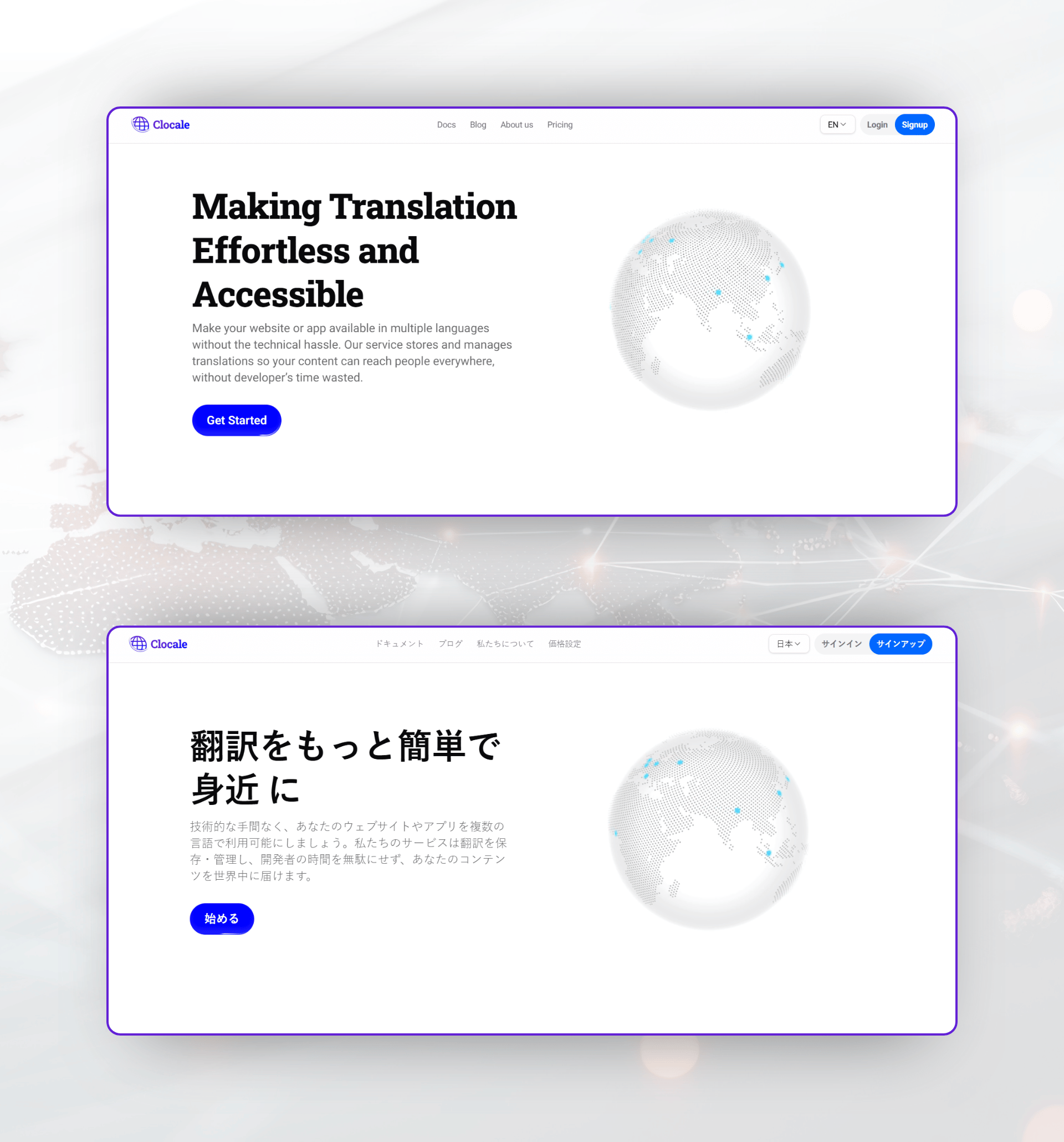
Translation simply means converting your website’s copy and content into another language, nothing more and nothing less. Your visual design, layout, CTA button placement, and overall user experience remain completely untouched, as shown in Clocale’s localized sites for English and Japanese audiences.
In these two versions, the website copy is translated into different languages to match each audience. Only the text changes, while the images and overall theme remain exactly the same across both versions.
Website Localization, on the other hand, answers the question: How do we make this feel local to the target audience? It includes translation but also adapts visuals, formatting, local regulations, and cultural content.
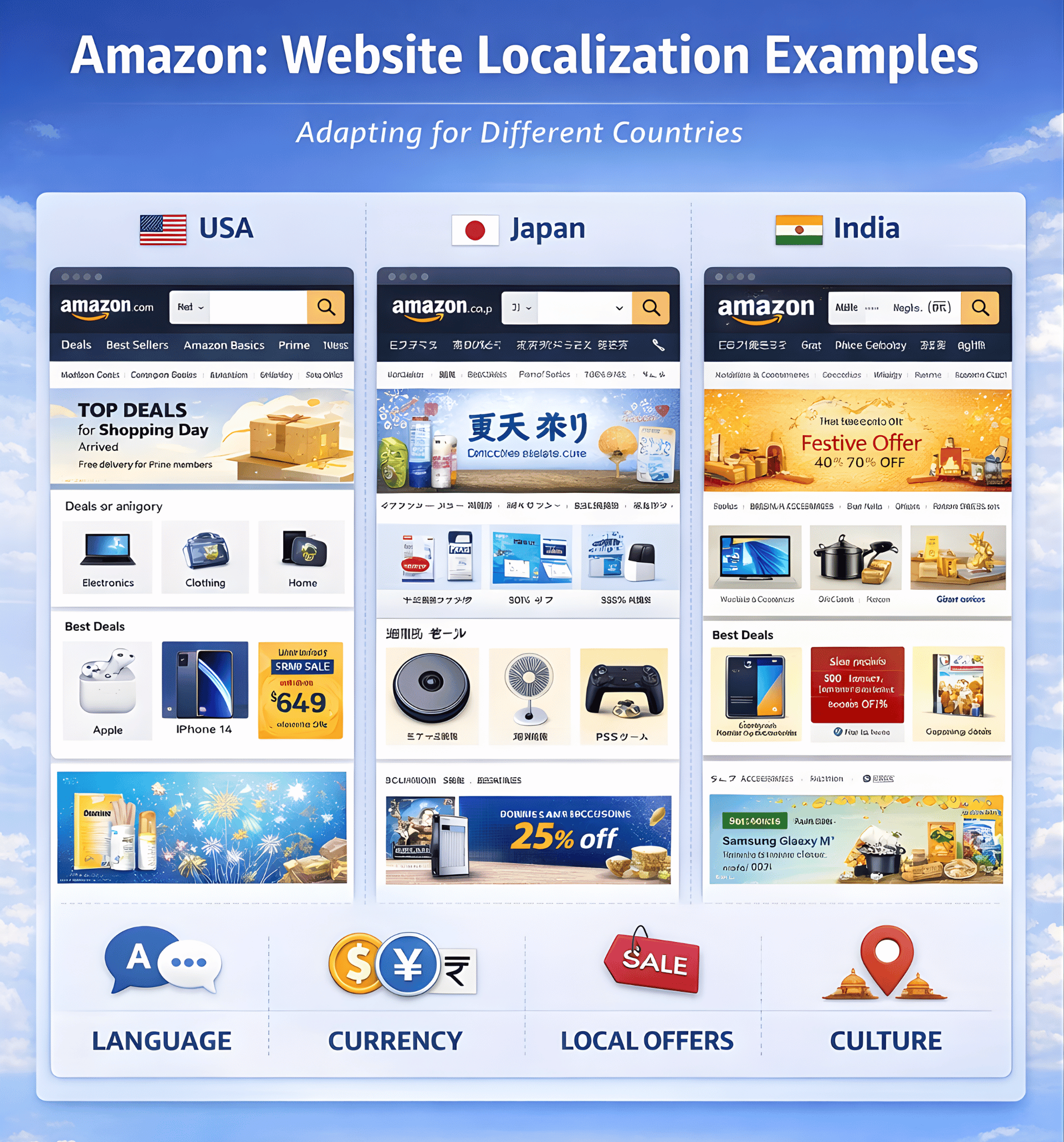
Let’s look at how Amazon targets American, Japanese, and Indian buyers with its localized websites:
- USA version: This version emphasizes convenience and fast delivery. It appeals to American buyers by highlighting services like Prime, one-click ordering, and same-day delivery. The homepage often showcases trending products and deals to grab attention quickly.
- Japan version: Japanese consumers value efficiency, reliability, and detailed product information. This version uses concise product descriptions, clear shipping timelines, and emphasizes customer reviews and ratings. The site also integrates local payment methods and seasonal promotions.
- India version: Indian buyers respond well to affordability and local relevance. This version highlights discounts, cashback offers, and local festivals. It also adapts categories and recommendations based on regional preferences and popular local brands.
(This image was generated using AI for informational and educational purposes only. Any trademarks, logos, or copyrighted material depicted belong to their respective owners.)
Here’s a simple analogy: Translation is like changing the clothing someone wears, while localization is tailoring the clothing so it fits perfectly and suits the occasion.
Imagine you are localizing a website for a Middle Eastern audience. Visitors there might prefer right-to-left (RTL) scripts, supportive customer service options in their language, and products that respect cultural norms. Simply translating the text into Arabic will not deliver this experience.
Another term sometimes mentioned in this context is Human vs. AI Translation. AI tools are great for quick translations, but human translators excel at capturing cultural nuances, idioms, and context. For true localization, human expertise is still essential.
Importance of Website Localization
Businesses that invest in localization open doors to customer loyalty, increased conversions, and stronger global brand presence. Let’s break down why website localization is so impactful.
1. Improved User Experience
Visitors are far more likely to stay and convert on a website that speaks their language and respects their cultural norms. Localization creates a smooth user experience by addressing local preferences in imagery, tone, and layout.
2. Increased Market Reach
With localization, companies unlock access to markets where language and cultural differences once kept them out. Consider regions with multiple dialects or languages; localized content ensures that your message resonates no matter the audience.
3. Higher Conversion Rates
Users tend to trust and engage with content that feels native. According to industry research, customers are more likely to make a purchase if the product information and checkout process are presented in their own language and cultural context. This is particularly relevant for sectors like e-commerce, financial services, and software-as-a-service platforms.
4. Competitive Advantage
Many companies still underestimate the power of localization. Those that do it well can outshine competitors who offer generic, untranslated content. Effective localization signals respect for the local audience and positions your brand as customer-centric.
5. Better SEO Performance
Website localization naturally improves search engine optimization (SEO) in target regions. Search engines reward content that is relevant to local users, including localized keywords, URLs, meta tags, and user engagement signals. If you want to rank organically in international search results, localization is a must.
For more insights on how search engines value localized content, you can refer to external resources like Google’s Webmaster Guidelines.
6. Enhanced Brand Perception
A localized website communicates professionalism and commitment. When users see a website that feels tailored to their preferences, they are more likely to view the brand as trustworthy and reliable. This helps with long-term brand loyalty and advocacy.
Despite its clear benefits, website localization is not without obstacles. Next, we explore some common localization challenges that businesses encounter and how to address them.
Challenges
Website localization is complex and requires thoughtful planning, especially for businesses entering multiple international markets. Here are some common barriers and considerations.
Cultural Missteps
One of the biggest challenges is avoiding cultural gaffes. Images, colors, symbols, and phrases that are acceptable in one culture may be inappropriate or offensive in another. Misunderstandings like these are among the most common localization mistakes brands make, and the reason why global businesses fail.
For instance, a hand gesture that means “okay” in one country might be rude in another. This is why localization goes beyond word conversion to include cultural adaptation.
Technical Complexity
Localization involves technical adjustments such as handling different character sets, text expansion (where one language requires more characters than another), and formatting for dates, currencies, and phone numbers. Localization tools and content management systems must support these variations.
Additionally, many companies struggle with integrating localization workflows into existing processes. Establishing clear guidelines, using localization management platforms, and collaborating with experienced teams can help businesses overcome these technical challenges.
Cost and Resource Allocation
Localization can be expensive, especially when targeting multiple markets. Costs include hiring translators and localization experts, purchasing tools, and ongoing content updates. Some companies underestimate these costs and are unprepared, which can delay projects.
However, businesses that see localization as an investment rather than an expense often reap significant returns through increased engagement and revenue.
Maintaining Consistency
Managing consistent messaging across multiple languages and regions is another hurdle. When updates are made to the original content, localized versions must be updated promptly to avoid mismatches. A version control system and clear workflows are essential to keep content aligned.
Regulatory and Legal Requirements
Some regions have specific legal and regulatory requirements for online content. For example, privacy policies, terms of service, and product disclaimers must comply with local laws. Not adhering to these standards may lead to legal issues. Working with local legal consultants or compliance experts can mitigate this risk.
Balancing Human and Automated Processes
As mentioned earlier, companies often debate the value of Human vs AI Translation. While AI tools can speed up translation and reduce costs, they may miss cultural subtleties or context that human translators catch. A hybrid approach, where AI is used for initial drafts and humans handle refinement and cultural adaptation, often yields the best results.
For highly specialized content, such as legal or medical information, human expertise is indispensable.
Content Prioritization
Deciding which parts of a website to localize first can also be difficult. Should you start with product pages, blog content, or customer support? A data-driven approach that analyzes traffic, engagement, and revenue impact can help organizations prioritize.
Another relevant area where localization is vital is Game localization, which involves adapting games not just linguistically but also in terms of cultural context, humor, audio, and interactive elements. Game publishers who ignore localization often find that their titles underperform in certain markets.
Steps to Successful Website Localization
Achieving a successful localization strategy requires a structured process. Here are key steps companies should follow:
1. Research Target Markets
Understand your audience’s language preferences, cultural nuances, and market expectations. Conduct competitive analysis and user research to guide your decisions.
2. Choose the Appropriate Localization Tools
Invest in a robust localization management system that supports workflow automation, version control, and collaboration. Tools that integrate with your CMS and development environment streamline the process.
3. Assemble a Skilled Team
Your localization team should include linguists, cultural experts, developers, SEO specialists, and project managers. Involving local consultants in target markets can provide invaluable insights.
4. Develop Style Guides and Glossaries
To ensure consistency, create comprehensive style guides and glossaries that outline tone, terminology, and formatting standards for each language or region. This also reduces errors and speeds up future localization efforts.
5. Localize Core Website Elements First
Start with high-priority sections like product pages, homepage content, support pages, and checkout processes. These areas directly impact user experience and conversion rates.
6. Test and Iterate
Before launching, conduct thorough testing with native speakers to catch errors and cultural issues. User testing can reveal unexpected challenges. After launch, monitor performance data and user feedback to refine your localization efforts.
7. Measure Results
Track key performance indicators (KPIs) such as bounce rates, conversion rates, search rankings, and customer engagement metrics in each locale. These insights help justify your investment and optimize future growth strategies.
Conclusion
In today’s global market, website localization is essential. It goes beyond translation to create culturally relevant experiences that boost conversions, improve user experience, and strengthen brand trust. While challenges like cultural sensitivity and technical complexity exist, the right strategy and tools make them manageable.
Companies that invest in localization early connect more deeply with international audiences, avoid common pitfalls, and open new markets. To grow sustainably on a global scale, speaking your customers’ language and earning their trust is no longer optional.
FAQ
What advantages does website localization offer for businesses?
Website localization helps businesses connect with global audiences by adapting content to local languages, cultures, and preferences. Key benefits include:
- Enhanced user experience and engagement
- Increased conversion rates and sales
- Strengthened brand reputation in international markets
- Access to new regional markets
- Better search engine visibility in local languages
How would you define website localization?
Website localization is the process of tailoring a website’s content, design, and functionality to suit the language, cultural context, and expectations of users in a specific region. It goes beyond translation by ensuring the website feels native to the target audience.
What is the main objective of localization?
The primary goal of localization is to make your products, services, or website culturally relevant and accessible to international audiences. This helps businesses build trust, improve engagement, and drive growth in global markets.
What are the key benefits of localization for companies?
Localization can significantly boost a company’s international success. Some major advantages are:
- Improved customer satisfaction and loyalty
- Increased sales and market reach
- Competitive edge over global rivals
- Compliance with local regulations and standards
- Stronger brand recognition across regions
Can you provide an example of effective localization?
A great example is Netflix, which tailors its platform for different regions:
- USA: Emphasizes trending shows, popular movies, and English-language content
- South Korea: Highlights K-dramas, Korean-language content, and local promotions
- Brazil: Offers Portuguese subtitles and dubs, features local films, and showcases regional favorites
This approach ensures users feel the platform is customized for their language, culture, and viewing habits.