
How to Win Asian, European, and Middle Eastern Markets Using Localization

Expanding into global markets is a huge opportunity, but it is not just about translating your website. Studies show that 90% of online shoppers prefer websites in their native language, and 76% are more likely to buy when content is localized. Ignoring localization could mean losing up to 40% of potential customers.
Localization goes beyond language. It shapes user experience, builds trust, and boosts conversions. In this guide, we will show how to win Asian, European, and Middle Eastern markets with strategies that truly resonate with local audiences.
Why Localization Is the Key to Global Market Success
Global expansion often fails for one simple reason. Businesses assume that translation alone is enough. In reality, customers buy from brands that feel familiar and culturally relevant.
Localization goes beyond language. It adapts your product, content, design, marketing, payment methods, and customer experience to match local expectations. When done right, localization helps you:
- Increase website traffic from international markets
- Improve conversion rates
- Build brand credibility
- Reduce customer acquisition costs
- Strengthen customer loyalty
Studies consistently show that consumers prefer to buy products in their native language. Even English-speaking users in Europe or Asia often feel more confident purchasing when content is localized.
Understanding the Differences Between Asian, European, and Middle Eastern Markets
Before building a localization strategy, it is important to understand how these regions differ in culture, communication, and digital behavior.
Asian Markets
Asia is incredibly diverse. Countries like Japan, South Korea, China, India, and Southeast Asian nations each have unique languages and user behavior patterns.
Key characteristics:
- High mobile usage
- Strong preference for localized content
- Cultural sensitivity in colors and symbols
- Platform-specific ecosystems such as WeChat in China
Asian users often expect detailed information and strong visual presentation. Trust is built through social proof, reviews, and local credibility.
European Markets
Europe consists of many countries with different languages and regulatory frameworks.
Key characteristics:
- Strong data privacy regulations
- High demand for transparency
- Multiple official languages within the same region
- Preference for clarity and structured content
Users in Europe value professionalism and compliance. Website localization must consider GDPR compliance, local currencies, and payment systems.
Middle Eastern Markets
The Middle East is culturally rich and rapidly growing in digital adoption.
Key characteristics:
- Arabic as a primary language in many countries
- Right-to-left reading structure
- Cultural sensitivity in visuals
- Growing e-commerce market
Localizing for Arabic markets requires layout adjustments, not just translation. Tone and imagery should reflect cultural values and respect traditions.
Step-by-Step Guide to Successful Global Market Localization
Step 1: Conduct Deep Market Research
Successful localization begins with research.
Analyze:
- Local competitors
- Search behavior in target languages
- Preferred social media platforms
- Payment methods
- Cultural norms
Use keyword research tools to find highly searched local terms instead of directly translating your English keywords. For example, search intent in Japan may differ significantly from search intent in Germany or the UAE.
Understanding these insights ensures your localization strategy aligns with real user behavior rather than assumptions.
Step 2: Adapt Your Website for Each Region
For international customers, your website usually serves as the first point of contact with your brand. This makes website localization a critical step in global expansion.
Important elements to localize:
- Language and tone
- Currency and pricing format
- Date and time formats
- Measurement units
- Contact information
- Legal pages
For example, European users expect prices in euros or local currency with tax information clearly displayed. Middle Eastern users may expect Arabic language options and right-to-left interface support.
Do not simply use automated translation widgets. Instead, create region-specific versions of your website with culturally adapted content.
Step 3: Optimize for Local SEO
Localization without search engine optimization limits your visibility.
To win in Asian, European, and Middle Eastern markets, you must:
- Conduct local keyword research
- Create localized meta titles and descriptions
- Use hreflang tags
- Build local backlinks
- Optimize content for regional search engines
For example, China relies on Baidu rather than Google. South Korea uses Naver extensively. Understanding local search engines improves your ranking potential.
Focus on creating valuable, localized blog content that answers region-specific queries. Avoid keyword stuffing. Maintain natural keyword density under 4 percent to keep content readable and compliant with SEO best practices.
Step 4: Localize User Experience and Design
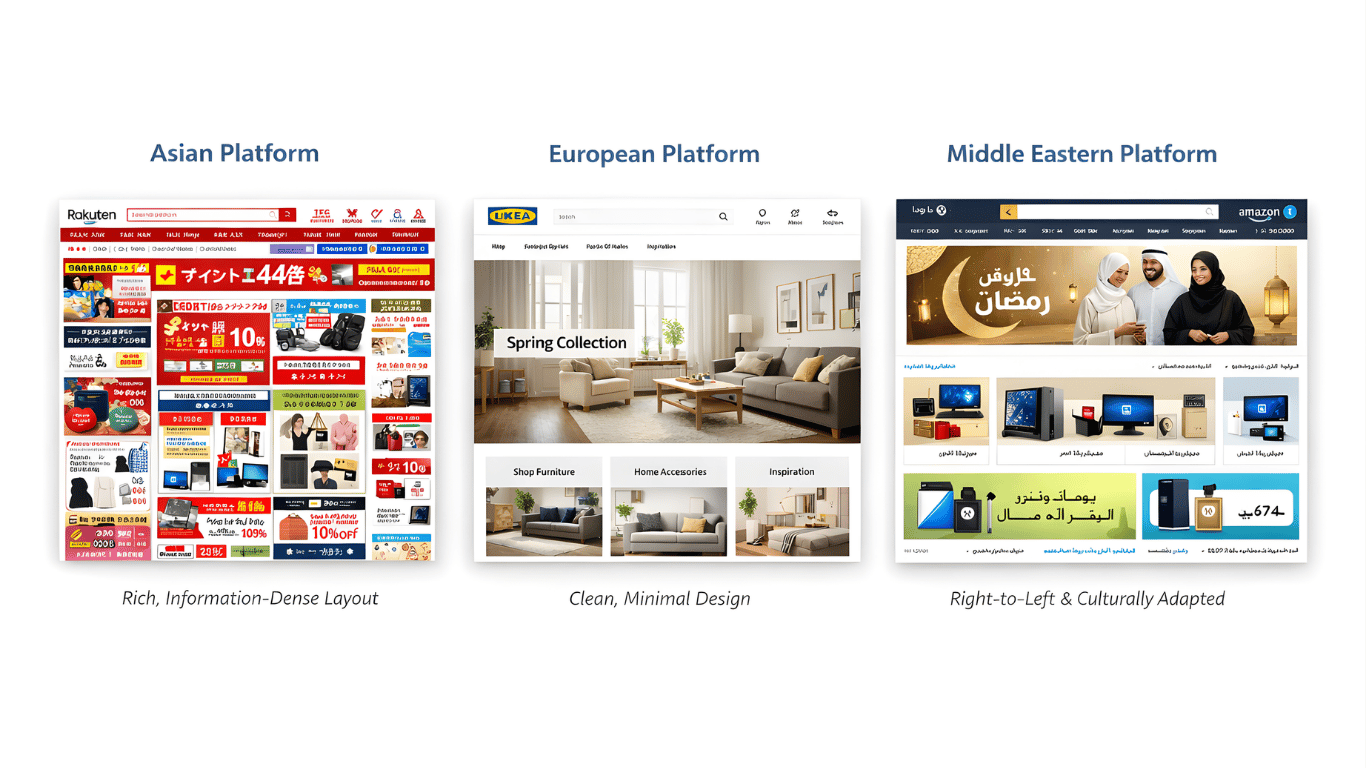
Design preferences vary significantly across cultures. This is where UX localization plays an important role in market success.
Asian platforms may include richer visuals and information-dense layouts. European websites often prefer clean, minimal, and structured interfaces. Middle Eastern platforms must adapt to right-to-left layouts and culturally appropriate visuals.
Consider:
- Navigation style
- Button placement
- Color psychology
- Imagery and symbolism
- Call to action language
Even small adjustments can improve engagement and conversion rates dramatically.
Step 5: Use Culturally Relevant Content Marketing
Content marketing must reflect local context.
Avoid translating idioms, humor, or cultural references directly. Instead, adapt your messaging to resonate emotionally with the target audience.
For example:
- A campaign focusing on individual success may perform well in some Western European markets.
- Community-oriented messaging may resonate more in parts of Asia or the Middle East.
Localized blog posts, social media content, and email campaigns build stronger connections and improve brand trust.
Step 6: Choose the Right Translation Strategy
One of the biggest questions companies face is human vs. AI translation. While AI-powered tools provide speed and cost efficiency, human translators offer cultural nuance and contextual accuracy.
The ideal approach often combines both. Use translation tools for initial drafts and workflow management, but rely on human review to ensure tone, accuracy, and cultural relevance.
Context matters significantly. Implementing In-context Translation ensures that translators see how content appears within the interface. This reduces errors and improves clarity.
Businesses must also understand different types of localization. These include linguistic localization, cultural adaptation, technical localization, and multimedia localization. Choosing the right combination depends on your industry and product type.
Step 7: Localize Payment and Customer Support
Payment preferences differ across regions.
In Asia, digital wallets and local payment apps are widely used. In Europe, bank transfers and regional payment gateways are common. In the Middle East, cash on delivery remains popular in some markets.
Providing familiar payment options reduces friction and increases trust.
Customer support must also be localized. Offer multilingual support channels, region-specific FAQs, and culturally sensitive communication styles.
Step 8: Build Local Partnerships
Strategic partnerships accelerate trust building in new markets.
Consider collaborating with:
- Local influencers
- Regional distributors
- Industry associations
- Community organizations
Local partnerships demonstrate commitment to the market and improve brand credibility.
Step 9: Test, Measure, and Improve
Localization is not a one-time project. It is an ongoing process.
Track:
- Conversion rates by region
- Bounce rates
- Customer feedback
- Revenue growth
- Search rankings
Run A/B tests to compare localized versions and optimize based on data. Continuous improvement ensures long-term success in competitive global markets.
Common Localization Mistakes to Avoid
Many companies lose revenue and credibility due to avoidable localization errors. Here’s a deeper look at what to watch out for:
- Direct word-for-word translation
- Ignoring cultural differences
- Using incorrect imagery
- Overlooking regulatory requirements
- Failing to test localized versions
Even small localization mistakes, such as a mistranslated phrase, an inappropriate image, or an overlooked cultural nuance, can damage your brand’s reputation in new markets. Customers notice when content feels inauthentic or insensitive.
The Business Impact of Strategic Localization
Companies that invest in strategic localization often see measurable growth in international markets because they adapt products, messaging, and user experience to fit each audience’s language and cultural expectations.
Research and real-world examples show clear business benefits, including:
- Higher international revenue
- Increased customer retention
- Stronger brand positioning
- Competitive advantage
When brands localize effectively, they build emotional connections with customers because visitors feel understood and respected in their own language and cultural context, which leads to greater trust and recommendations.
Real-World Example:
Netflix
Netflix invests heavily in localization by offering subtitles, dubbing, and region-specific content tailored to different languages and viewing preferences. This strategy has driven extraordinary global growth: Netflix now earns a significant majority of its revenue from international markets, and international members frequently watch content in languages other than English.
Shopify Merchants
Small online retailers using Shopify have boosted conversion rates by localizing storefronts to support local currencies, tax rules, and payment methods. For instance, one Shopify retailer expanded into multiple countries and now gets a notable share of total revenue from international sales thanks to localization features.
Read more examples here.
Conclusion
Winning Asian, European, and Middle Eastern markets requires strategy, cultural awareness, and a customer-focused approach. Localization helps your brand connect with global audiences on a deeper level.
By adapting your website, optimizing for local search, refining user experience, and combining technology with human expertise, you build a strong presence. Speaking your customers’ language literally and culturally allows your brand to belong in new markets.
FAQ
What is localization, and why is it important for global markets?
Localization is the process of adapting your website, product, and marketing content to meet the language, cultural, and user expectations of specific countries. It helps businesses build trust, increase conversions, and succeed in Asian, European, and Middle Eastern markets.
How does website localization help increase international sales?
Website localization improves user experience and boosts sales by:
- Allowing users to navigate and understand your website in their native language
- Adapting content, design, and functionality to match local culture and expectations
- Reducing bounce rates and increasing engagement, which leads to higher conversions
Should I use human translation or AI translation for localization?
Both human and AI translation have benefits. AI translation provides speed and cost efficiency, while human translation ensures cultural nuance and accuracy. Combining both strategies can create high-quality localized content.
What are the key steps to localize my business for different regions?
The key steps include:
- Conducting market research to understand local users and competitors
- Adapting website content and design to each region
- Optimizing for local SEO and search engines
- Creating culturally relevant content marketing campaigns
- Providing region-specific payment and customer support options
- Continuously testing and improving localized experiences
Which countries in Asia, Europe, and the Middle East are best for early localization efforts?
Target countries with high internet usage, growing e-commerce adoption, and strong purchasing power. For example, Japan, South Korea, and Singapore in Asia; Germany, France, and the United Kingdom in Europe; and the United Arab Emirates, Saudi Arabia, and Qatar in the Middle East.